Friday, January 22, 2016

pGLO Analysis Questions

1.


2.  Two new traits that our transformed bacteria had was Ampicilin and arabinose sugar
3. For the -pGLO LB and -pGLO LB/amp , there are no colonies because they did not get the plasmid.
For the +pGLO LB/amp, there are about 5 colonies because it got the plasmid. For the +pGLO LB/amp/ara, there are about 30 colonies because it has arabinose sugar which leads to getting more colonies and plasmids
4. To allow pGLO to grow more colonies of bacteria
5. GFP is used for tagging genes for clearing expression or limiting profiles, studying protein to protein interactions and visualizing promoter activity
6. An example of genetic engineering is cloning.


Sunday, January 17, 2016

Candy Electrophoresis Lab

1. The dyes are dyes that match the reference ones. Our dye bands were the same size, the colors were the same than the reference bands. It had only one color band and the dyes moved in the right direction. 
2. Fast Green FCF, because it has more negative charge and is also a lighter color.
3. Manufacturers put food coloring in dog food to attract people who have a dog buy it.

4. FD&C Dye       Color                Natural Alternative                             Source of Natural Dye
    Red 40               Red         Anthocyanins, Carmine, Cochineal                Bugs, Candy
    Yellow 5           Yellow       Turmeric, Beta Carotine, Annatto            Chips, jams, Candy
    Blue 1                Blue       Grape juice concentrate, Grape skin extract  Indigo, Woad Plant
    Red 40 Lake      Red      Grape juice concentrate, Grape skin extract  Bugs, Aluminum Hydroxide,                                                                                                                      Candy
    Blue 2 Lake       Blue        Coal Tar, used to color denim jeans         Makeup Products, Pill Coatings
    Yellow 6 Lake   Yellow     Paprika, Beta Carotine, Annatto              Foods, Drugs, Cosmetics
5. The size of the Molecule and the electrical charge

6. Gel Electrophoresis

7. They are separated when the DNA is put into the wells of the Gel box. This happens when the power goes on. When it goes on, the molecules, which have a negative charge move towards the positive electrode because opposite charges attract. 

8. The molecules with less Daltons separate quickly with 600 Daltons. It will move deep in the Gel With 1000 Daltons, molecules will spread quickly, but will spread slower than 600 Daltons. It will move deep in the gel, but not as deep as 600 Daltons. With 2000 Daltons, It will spread slower than 1000 Daltons, but it will not move as deep as 1000 Daltons. With 5000 Daltons, It will spread very slow and will not move very deep in the gel.


Wednesday, January 13, 2016

Recombinant DNA Blog Summary

In this lab, we made a model of recombinant DNA using our understanding of recombinant DNA technology. Restriction enzymes are enzymes produced by bacteria that cut DNA whenever it reads a specific sequence. They work to create different sequences. We used Hin III because it was close to the insulin sequence. If we used an enzyme that cuts the plasmids in two places, more fragments to the DNA would be made. We made a kanamycin restriction enzyme because we could use it in a petri dish to take bacteria from the plasmid. Kanamycin can treat infections that are caused by bacteria. We would not use ampicillin as a antibiotic because it treats infections that occur in the urine.
 We made the plasmid ring and cell DNA strand and we used the enzymes to match it within the insulin of each strip. We then tested the enzymes using our rings and DNA strand. We cutted our plasmid in a staggered fashion to make the enzyme. This process is important to help inspect for bacteria in the plasmid for the DNA. This process can be used to make useful products that can avoid bacteria to come in the plasmid and cure cancers that can't be cured currently.

Tuesday, January 5, 2016

New Year's goals

1. My goal for this semester is to get better grades in all of my classes. I will achieve this by studying for tests and quizzes ahead of time and not studying it on the day before the test is given. For math, I will do more practice problems and word problems so I know the material better. For English, I will read some books to help improve my writing skills. For biology, I will read the textbook more often, watch the vodcasts, and make flashcards for terms and key ideas more often when preparing for the test.
2. My goal for biology is to continue to do well on lab conclusions. I will make sure I will get all of the requirements for a good lab conclusion and I will try to type faster to get it done in a quicker manner and have more time to check it then last semester when I finished at a slow manner and did not have a lot of time to check it.

Thursday, December 10, 2015

Unit 5 Reflection

         In unit 5, we learned about Walking the Dogma. It includes learning about our genetic code, DNA, the central dogma of biology, mutations, and gene expression and regulation. We did some labs to explain more about DNA.
       We learned about our genetic code. We learned about the structure of our code which includes a double helix which is two strands twisted around each other and is made of nucleotides. Nucleotides are made up of three parts, an anitrogen base, a phosphate group and a sugar. In our genetic code, our DNA is antiparallel which is when each nucleotide bonds with another nucleotide. Also our code is made of nitrogen bases that includes purines and pyrimidines. We learned about our DNA. It includes semi conservative DNA replication. It includes many steps that includes unzipping and zipping. The result of this is getting 2 identical strands. We learned that the base pair rules are A=U, C=G, T=A.
       We learned about RNA and DNA and its structural differences like being single stranded, having rbose and containing uracil. The function of RNA is that it serves as a temporary copy of a gene , delivers the copy to the ribosomes, and ribosomes would use the copy to make proteins. We learned about transcription and translation. Transcription is a process where RNA polymerase reads and copies DNA code for the messenger RNA. Translation is when the messenger RNA arrives at the ribosome and is read 3 bases at a time and turned into protein. The result of this is that a long chain of amino acids are made and chains of amino acids twist, folds and combines with other chains. We learned about the types of mutations . It includes point mutation where a change in one or two base paris of DNA, very small and are very common. It also includes frameshift mutation, Substitution , insertion and deletion. Frameshift mutation is a mutation that includes insertion and deletion. Insertion is when an extra base pair is added to the code. Deletion is when a base pair is left out of the code.
       Lastly, we learned about gene expression and regulation.  We learned that gene regulation is cells that don't want to waste energy or over express genes and have a variety of steps used to control the expression of a single gene. We learned about eukaryotic regulation. It's more complex that bacterial regulation and proteins will bind before a gene and are required for the gene to be expressed.

Tuesday, December 8, 2015

Protein Synthesis Lab Conclusion

1. To make a protein, a section of DNA is copied by an enzyme to create messenger RNA. The messenger RNA leaves the nucleus and travels to the cytoplasm. The messenger RNA then bonds with a ribosome. The ribosomes reads a codon and determines the amino acid that corresponds with the sequence and is determined by the codon that is read by the ribosome. They are bonded together and when the messenger RNA is done translated, it is folded up to become a protein.


https://upload.wikimedia.org/wikipedia/commons/thumb/3/38/Protein_primary_structure.svg/2000px-Protein_primary_structure.svg.png


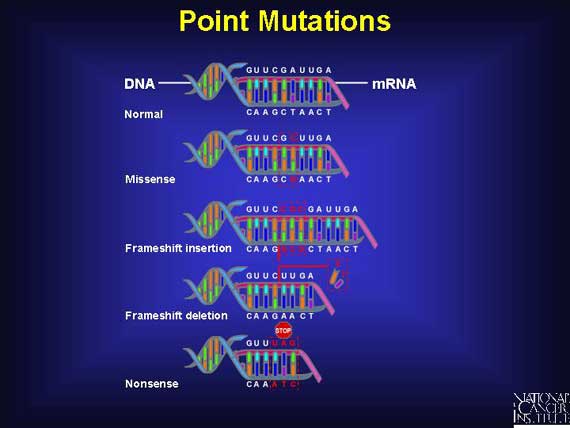
2. The mutation that had the most effect to the protein is frameshift mutation because it involves insertion and deletion that has a great effect to the amino acids. When the DNA inserted another base, the amino acids changed into different amino acids. When the DNA deleted a base, the amino acids started twice. The weakest mutation is substitution because it only substitutes a base for another and does not effect the amino acids much as most of the proteins still were the same from the original amino acid sequence.


https://upload.wikimedia.org/wikipedia/commons/b/b1/Point_Mutation.jpg


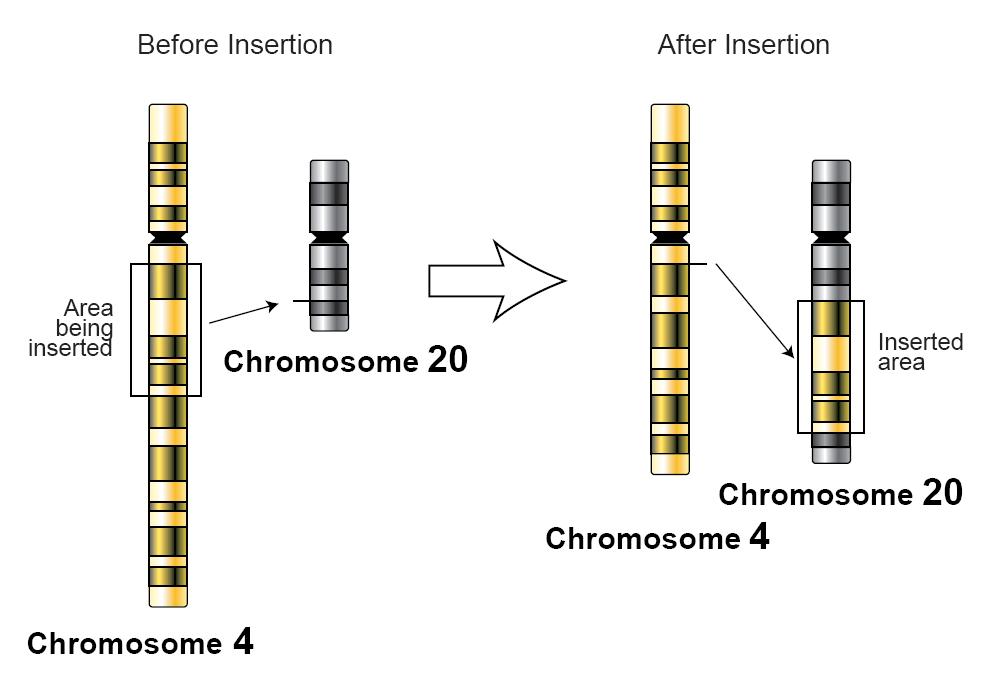
3. In step 7, I chose insertion because it's a harmful mutation. Insertion is more effective to the amino acids than deletion and substitution because more amino acids turn into different amino acids than deletion and substitution. It matters where the mutation occurs because has to occur between the codons.

https://upload.wikimedia.org/wikipedia/commons/0/06/Insertion-genetics.png

4. Mutations can affect our life by causing proteins to not work properly and can cause disorders in the body.
Conditional Mutations:
A type of mutation that affects the phenotype by temperature.


http://www.nature.com/scitable/content/5140/10[1].1038_ncb437-f2_full.jpg


Sunday, December 6, 2015

DNA Extraction Lab

In this lab, our question was how can DNA be separated from cheek cells in order to study it? Our result was alcohol, a non polar mixture and DNA, a polar mixture separated into layers and the DNA precipitated to the interphase of the mixture and DNA went to the alcohol layer. During this experiment, we used our teeth to scratch our cheek cells and got a bit of Gatorade and swished it in our mouth for 30 seconds which is an example of homogenization. We then added salt, pineapple juice, a catabolic proteases, and detergent to lyse the cell membranes. We then added alcohol tocreate 2 layers. The DNA then rose to the alcohol layer and could be picked up with a transfer pipette. This supports the claim by showing that DNA can be separated by nonpolar and polar liquids.

Even though the results we got from the lab was the right result, there was some errors that occurred during this experiment. One error is this lab was the time. In this lab, we did not count exactly 5 minutes before checking the Gatorade mixture. This affected how some of the DNA did not wrap around. Another error was the amount of Gatorade added to the test tube.  We may have added too much in the test tube which affected how much alcohol we added.  We may not have added enough for more DNA to precipitate to the surface. In order for these errors to not occur, we should be more careful and follow instructions better.

In conclusion, the purpose of this lab was to determine how to extract your own DNA. This lab relates to what we learned about DNA. We learned that it can be found in the nucleus and organisms and what is in the DNA. This can be applied to other concepts relating to observing DNA in human and living organisms with your own eyes and learning how to remove DNA from humans and living organisms to make observations.